

Included in Christ
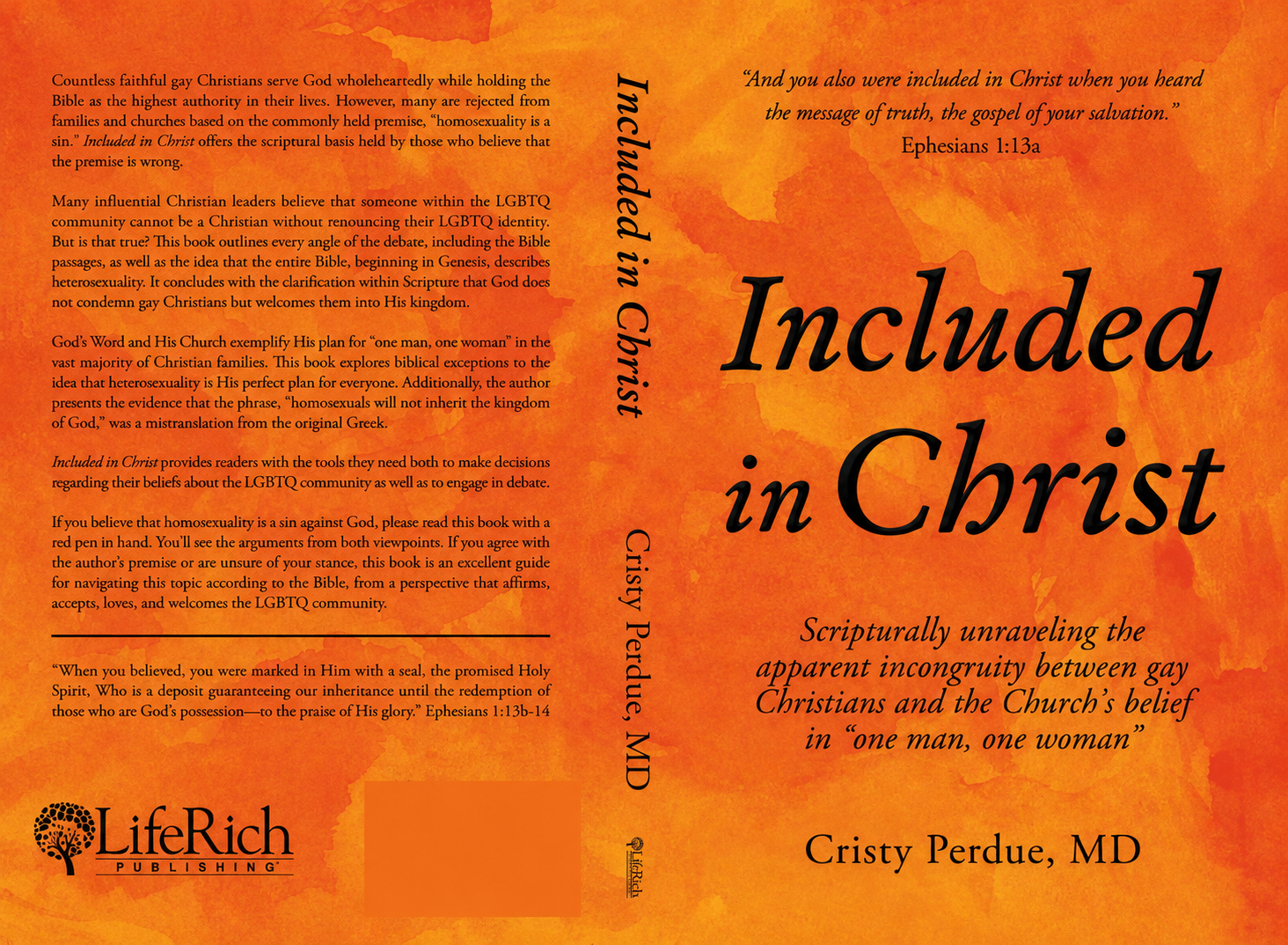
This book is an excellent guide for navigating the important topic of the inclusion of gay Christians in our churches, according to the Bible, written to present the scriptural basis held by those Christians who believe that gay Christians are welcomed and blessed by God.
Available in print, e-book, and audible.
“And you also were included in Christ when you heard the message of truth, the gospel of your salvation. When you believed, you were marked in Him with a seal, the promised Holy Spirit, Who is a deposit guaranteeing our inheritance until the redemption of those who are God’s possession – to the praise of His glory.” Ephesians 1:13-14
Read the first three chapters & see the table of contents
Chapter 1: The Traditional Christian Approach to Homosexuality
Thus far in history, many traditional, evangelical, and other mainstream churches have chosen what appears to be the most conservative and safest approach regarding homosexuals, or gay people. Churches have been friendly to gay people but have not allowed them to participate in membership or ministries. Some churches with traditional views may allow those who maintain celibacy to participate, but would not consider a gay couple for membership or ministry. The approach is thought to be safe because the traditional argument holds to the premise, “homosexuality is a sin,” and Christians cannot condone sin.
Nevertheless, gay Christians and gay Christian couples are in our churches all over the world. Some Christians were raised in church and attended for many years before they realized that they were gay, or same-sex attracted. Other gay people have come to church later in life, seeking a closer relationship with Christ. Gay people are in virtually every church, whether congregants are aware of it or not. The steadfast witness and undeniable testimony of faithful gay Christians is opening the door for conversation between the traditional church and Christians who support the inclusion of gay people in local churches.
If all gay people are living in sin because of their same-gender attractions, then the church is doing the right thing to condemn them, and probably is not going far enough. However, if God is honored within monogamous, permanent, committed, Christ-centered relationships, and in the lives of single gay Christians, then the church has misinterpreted key Scriptures that have been mistranslated, misunderstood, and misused to condemn gay Christians unjustly.
Proverbs 17:15: “Acquitting the guilty and condemning the innocent – the Lord detests them both.” It is my conviction that we must, therefore, consider this matter more thoroughly, as I believe the traditional Christian community has condemned the innocent.
I hold that the traditionalists’ premise, “Scripture is clear that homosexuality is a sin,” is wrong. I present my case directly from the Bible. For decades, the vast majority of Christendom, including countless trusted leaders, have heralded this phrase. For those in agreement, there is comfort and assurance that this unambiguously reflects the truth. Our modern Bible translations outright condemn homosexuality. Thus, it is not unreasonable that many Christians currently believe that homosexuality is a sin.
What is abundantly clear in Scripture is that male sexual acts involving abuse and exploitation, and all same-gender sexual activity related to idol worship and rejection of our Creator, are sinful. Unfortunately, since 1946, Bible translators have erroneously referred to those acts as a group of people, namely, “homosexuals.”
Traditional Christians refer to marriage as a sacred institution designed by God exclusively for one man and one woman. There are biblical exceptions to the one man, one woman tenet, which we will explore. Scripture records one of these exceptions in God’s voice; Jesus also gave us one exception to “one man, one woman.” We will also consider biblical exceptions to other previously held traditional positions within Scripture, to which traditionalists no longer hold.
The Word of God absolutely does not change. It is the same yesterday, today, and forever. God’s inspired Scripture, in its original form, is the inerrant, infallible Word of God. Translations and interpretations, however, do change over time. Our understanding of Scripture changes as the Holy Spirit within us guides us to understand His will for our lives and for His Church.
A dear friend of mine is a gay woman who has never known Christ. Over the years, I have prayed for her salvation. She was invited to a megachurch in Atlanta around 2007. When she began attending, I was thankful and optimistic about God’s work in her life. She enjoyed the church and community so much that she wanted to volunteer. She signed up to help with the nursery. After her first Sunday volunteering, she was told that she was not allowed to be in the nursery. She requested to meet with the pastor. When she asked why she was not allowed in the nursery, he said, “because you are gay.” Genuinely confused, she asked, “what difference does that make?” He said, “I’m sorry. That is our policy.”
I am dumbfounded by this event. My friend had never in her life heard the gospel, beyond what the pastor had said from the pulpit. He could have presented the good news of the gospel of Jesus Christ to my friend instead of simply rejecting her. At this point, over a decade later, I am in a position to present the gospel to her. She graciously declines, but I continue to pray that she will one day see that God loves and adores her and does not reject her. The church desperately needs to look more carefully into this matter and engage gay people, rather than reject them.
Consider another example, this one involving a gay Christian who believes that Scripture condemns homosexuals.
As a gay Christian [man], I am looking at two possibilities for my life: I could marry another man, and live the rest of my life with nagging doubts that I have sacrificed my relationship with God for this marriage. Or, I could choose not to marry a man, and blame God for the loneliness that I feel. There’s a third option, and that’s to kill myself now, while I still am in good relationship with God. -Anonymous
The following are statistics from a study published by Andrew Marin in 2016: 86% of LGBT people were raised in church. 54% leave by the age of 18, and many of them did not want to leave. 76% of them are open to returning to church. 92% of those who want to return to a local church are not asking the church to change its theology, but to accept, welcome, and love them.
In general, Christian churches want to welcome people into a saving relationship with Christ. However, the church leadership cannot condone sin. Churches recognize that people are imperfect, and everyone sins. The unique situation with gay Christians, however, is present when gay Christians do not agree with the church and believe that same-gender attractions and monogamous, covenantal relationships are not sinful. In other words, the church will accept someone who sins, provided that the person agrees he is sinning. But the church cannot accept someone who believes his relationship is not sinful when the church believes he is living in sin.
Can a monogamous, permanent, Christ-centered, same-gender relationship be blessed by God, or is it sinful? Our failure to agree on the answer to this question is the crux of this issue.
As churches continue to exclude gay Christians from membership and ministry, please recognize the bigger picture. Exclusion from church suggests exclusion from the family of God. Gay people in the community are not welcomed into these churches, and many believe that God’s saving grace does not extend to them. Throughout this book, I will refer to the issue of excluding gay Christians from membership and ministry in traditional churches, but this argument extends to sharing the gospel with those who do not know Christ.
My goal is to present the scriptural basis held by those Christians who believe that gay Christians and Christ-centered, covenantal, permanent, same-gender relationships are blessed by God. I plan to demonstrate that the Bible does not condemn gay people or monogamous, loving, gay couples. One can believe the Bible to be the sacred Word of God and faithfully, confidently determine that there is no biblical reason to disapprove of gay people or gay couples.
Until churches realize the possibility that gay people can and should be included in the local church, even while gay, we will not be able to effectively minister the love of God and the gospel of Jesus Christ to this beautiful segment of God’s creation.
For those who cannot consider homosexuality to be anything other than a sin against God’s design for humanity, I humbly request and thank you for hearing me out through the pages of this book.
Chapter 2: Gay Christians?
Imagine if you will, a room full of 400 people who have all come together to worship the Lord. There’s a band up front. There’s praise music. People are worshiping the Lord, some with hands in the air, some prostrate on the floor. Someone in the crowd has a beautiful giant orange and red flag, and he’s waving it rhythmically with the music. It’s a beautiful scene of worship. The leader says into the microphone, “if you have your prayer language, just begin to pray in tongues as the Spirit leads.” And then gently, softly, people are praying in the Spirit, worshiping and thanking the Lord. The music continues, and another song is sung. Thereafter the voices of people praising God can be heard. Eventually, among the sounds of worship to the Lord, one voice stands out. This one voice is singing, and all the other voices and sounds die down.
Amazingly, the man holding the flag is now in the center of the auditorium in front of the stage, singing, beautifully, slowly, in tongues. And the whole crowd is silent. Then it ends. You could hear a pin drop. Seven seconds later, the bassist on the platform sang the interpretation: “I dwell among you. I call you My friends. I dwell among you, and I hold your hand. I am the Lord your God, and I go before you now. Lift up your head in this place, and wear My heavenly crown.” The tongues and interpretation were both sung in the same tune. It was incredible.
More people lay down, prone, on the floor, on their faces before God. Many were crying; some were laughing and jumping and praising God out loud. There was an atmosphere of worship in that room unlike anything I have ever experienced. This event involved 400+ Christians, approximately 95% of them from the LGBTQ community. The Immersed Conference 2018 was titled Healing and Miracles by Faith. It took place in July 2018 in Atlanta, Georgia.
There are large groups of LGBTQ Christians all over the world who meet periodically. The Reformation Project and Q Christian Fellowship are other examples of LGBTQ-affirming Christian groups who hold annual meetings. The Covenant Network, which hosts the Immersed Conference every year, held ten conferences in 2019 in cities throughout the United States. The European Forum of LGBT Christian Groups hosts conferences throughout Europe.
I describe this worship scene because I know that many people do not realize that gay Christians even exist. Some cannot imagine that gay people would take any interest in Christianity since the church typically rejects them. Conversely, others assume that homosexuals could not even be Christians because they believe homosexuality to be sinful.
Throughout this book, I hold that gay Christians are, in fact, Christians, having trusted in Christ, His life, death, and resurrection. If the reader believes that a gay person could not be a Christian, I encourage you to consider a simple example, a 17-year-old Christian boy who has just realized that he has same-gender attractions, or a 25-year-old Christian man who has prayed since he was a teenager to be straight. This man follows Christ, is celibate, and recognizes that he is a sinner in need of a savior. But he simply cannot and does not deny that he is attracted to men, despite never having acted on his feelings. Gay Christians are Christians, first.
The word gay does not imply any action. It refers to something that one senses from within himself. Some may reject even that notion and believe that gay people have chosen to be gay. Here, the word gay simply refers to someone who realizes that they feel most comfortable in a romantic relationship with someone of the same gender.
The terms same-sex attracted and gay are used interchangeably throughout this book. Some gay Christians believe that romantic intimacy within a covenantal relationship can be blessed by God. Some gay Christians do not think that same-gender, romantic expression is permitted, and thus choose celibacy. Whether celibate or in a committed, monogamous relationship, both of these examples refer to gay or same-sex attracted Christians.
Christians who believe that God blesses permanent, monogamous, committed, Christ-centered, same-gender relationships are referred to as gay-affirming, or simply, affirming. Those who hold that God does not bless any same-gender intimacy are referred to as non-affirming, or non-gay-affirming.
I am a Bible-believing, evangelical, Holy Spirit filled Christian. I am also a gay woman in a permanent, Christ-centered, committed relationship with my partner, Sue. My identity is in Christ, first and foremost. I have recently completed a re-reading and a study of the Bible before beginning the writing of this book. I want to show Christians that one can maintain one’s faithfulness to God and His Word and affirm gay Christians, despite all that we were taught and grew up believing.
To my beloved non-affirming reader, I owe a great debt for your time. I recognize the vulnerability it takes for some of you to read something so far out of the bounds of your experience and walk with God. I thank God for you, and I pray that the Holy Spirit brings you and me into agreement with His heart on this issue very soon.
Chapter 3: Does the Possibility Exist?
My goal is to demonstrate that God lovingly, legitimately, purposefully creates some people without the capacity for heterosexuality and that He does not exclude them from His kingdom. Some Christians immediately assume that one must disregard the Bible to believe this, as they think that homosexuality is a sin.
Conversely, based on their understanding of the teachings of Christ, others cannot imagine that the exclusion and disapproval of gay people is justified. Nevertheless, modern Bibles read that homosexuals will not inherit the kingdom of God. Thus, many people do not consider the Bible to be sacred Scripture.
The Bible is the Word of God and can be trusted as such. I will carefully unravel the apparent incongruity between the traditionalists’ claim that homosexuality is a sin and the faithful Christian witness of countless gay Christians and straight Christian allies.
“For You created my inmost being; You knit me together in my mother’s womb. I praise You because I am fearfully and wonderfully made.” (Psalm 139:13-14a)
Affirming Christians believe that Scripture suggests we are fearfully and wonderfully made, even while gay. Non-affirming arguments would not disagree that even gay people were fearfully and wonderfully made. However, traditionalist Christians believe that God created everyone with the capacity for heterosexuality, but that the results of sin in the world have led to same-gender attractions.
One view that some traditionalists consider is that “God’s best” for everyone would be heterosexual marriage. However, perhaps God allows same-gender expression, although it was not His original plan, just as He allowed for divorce and for Israel to have a king. Jesus explained to the Pharisees in Matthew 19 that God had not planned for divorce “from the beginning,” but that due to their “hardness of heart,” Moses permitted divorce.
If there were a gay couple blessed by God in Scripture, the church would be inclusive of gay Christians. The standard I propose is whether or not even the possibility exists that God is honored in the lives of some gay Christians, even while gay, and that God is honored within some same-gender relationships. Is it possible that the church is wrong on this topic? If that possibility exists, and if we can find the error in our long-held premise, then the church would not want to continue to reject gay Christians and gay people.
Neither side, the traditionalists nor gay-affirming Christians, condones or promotes sin. As Paul noted in I Corinthians 4:4, “My conscience is clear, but that does not make me innocent. It is the Lord Who judges me.” Holding Scripture as the highest authority in my life, I will present my case, that God is not dishonored, but rather, He is pleased and honored by gay Christians and permanent, loving, monogamous, Christ-centered, same-gender relationships.
If the traditional, non-affirming argument reflects God’s heart and His will, then the information presented here will not be of any consequence. However, if God’s heart is reflected in the pages of this book, and if the world begins to recognize a move of God among gay and all LGBTQ Christians, then the church should consider this evidence. The traditional teaching on this subject is flawed. Scripture does not call for the rejection of gay Christians in the church. On the contrary, God’s saving grace through Christ is extended to all people, including gay people and gay couples.
TABLE OF CONTENTS:
Section 1: Introduction and thesis
- The traditional Christian approach to homosexuality
- Gay Christians?
- Does the possibility exist?
- The word “homosexuals” in the Bible
Section 2: Bible Passages
- I Corinthians 6:9 – Those who will not inherit the kingdom of God
- Arren and koite, from the Levitical passages
- Footnotes in The New American Bible and The Passion Translation
- Reverend David’s letter to Dr. Luther Weigle
- I Timothy 1:9-11 – The ungodly and sinful
- The list of behaviors in the NIV and eleven other translations
- The list using the footnote from The Passion Translation
- Romans 1:18-32 – The antithesis of grace by faith in Christ
- Were these gay people?
- Due penalty
- Paul’s description of these people and my response
- Porneia
- Reversing Paul’s premise
- Shameful, unnatural, reprobate
- “You who pass judgment do the same things.”
- Genesis 19:1-29 – The story of Sodom and Gomorrah
- Two passages from Leviticus
- Complementarity: One man, one woman
- One flesh
- Scriptural exceptions
- Procreation
- The creation story
- Exceptions, reversals, and other labels
- Women are not allowed to speak in church
- Slavery
- Deacons
- Elders
- Eunuchs
- Food sacrificed to idols
- The sun rises, and the sun sets
- Love your enemies
- Pearls, gold jewelry
- Greet each other with a holy kiss
- Head coverings
- Interracial marriage
- Remarriage
- Tithe
- One man, one woman
- Other Scriptures sometimes used to refer to gay people
- John 8:11b – Go and sin no more
- Matthew 19:1-12 – So shall a man leave his father and mother
- Proverbs 14:12 – A way that seems right to man
- Hosea 12:8 – They will not find in me any iniquity
- Revelation 3:16 – Because you are lukewarm
- Revelation 3:17 – Wretched, pitiful, poor, blind, and naked
- Ephesians 5:22-25 – Wives, submit to your husbands
- Mark 9:42 – If anyone causes one of these little ones to stumble
- Romans 15:5-7 – Accept one another
- Matthew 12:7 – Condemning the innocent
- Romans 14:4 – To judge someone else’s servant
- John 9:3 – Neither this man nor his parents sinned
- Acts 10:28b – I should not call anyone impure or unclean
- Romans 14:16 – What you know is good
- I John 3:6b – No one who continues to sin has seen Him
- Eating defiled food and forbidding people to marry
- Our freedom in Christ
- Sin requires harm
- Harm to God, to participants, or to neighbors
- “Promoting homosexuality” among children
- The early church agreed to disagree.
- Seared as with a hot iron
Section 3: History
- God heals: Ex-gay ministries
- Celibate gay Christians
- Where did this extreme aversion to gay people come from?
- Same-gender attraction does not imply pedophilia.
Section 4: Opinions/positions/propositions
- Should gay Christians be allowed to serve in the church, or should they remain visitors?
- Cornelius and family baptized in the Holy Spirit
- God told Peter not to call any man unclean or impure.
- If it’s true, how could we have gotten it so wrong for so long?
- Slavery
- Interracial marriage
- Bible translations: “helpful” clarifications, opinions, objections, errors
- Pastor Tony Campolo
- Pastor Clay Peck, Berthoud, Colorado: Agree to disagree
- The non-affirming positions
- Gay people cannot be Christians unless they renounce homosexuality.
- Gay people can be Christians but must remain celibate. Otherwise, their sin disqualifies them from membership in the local church.
- Non-affirming gay Christians
- Could we agree to disagree?
- Addressing other non-affirming arguments
- No question as to what the two Greeks words mean
- No new data
- Eunuchs
- Slippery slope
- Heart to heart – To my traditionalist, non-affirming sibling in Christ, one of us is wrong.
- My statement of faith
- Inconsistencies in the non-affirming argument
- “Don’t judge me.”
- New Covenant Church of Atlanta
- Various analogies
- Summarizing the premise: Is Scripture crystal clear that homosexuality is a sin?
- The clobber passages
- Complementarity – “one man, one woman”
- The whole of the Bible presupposes heterosexuality.
- Where do you stand? Email me: IamIncludedinChrist@gmail.com
- Appendix: The Baptism in the Holy Spirit
- Reference list
- Acknowledgments

